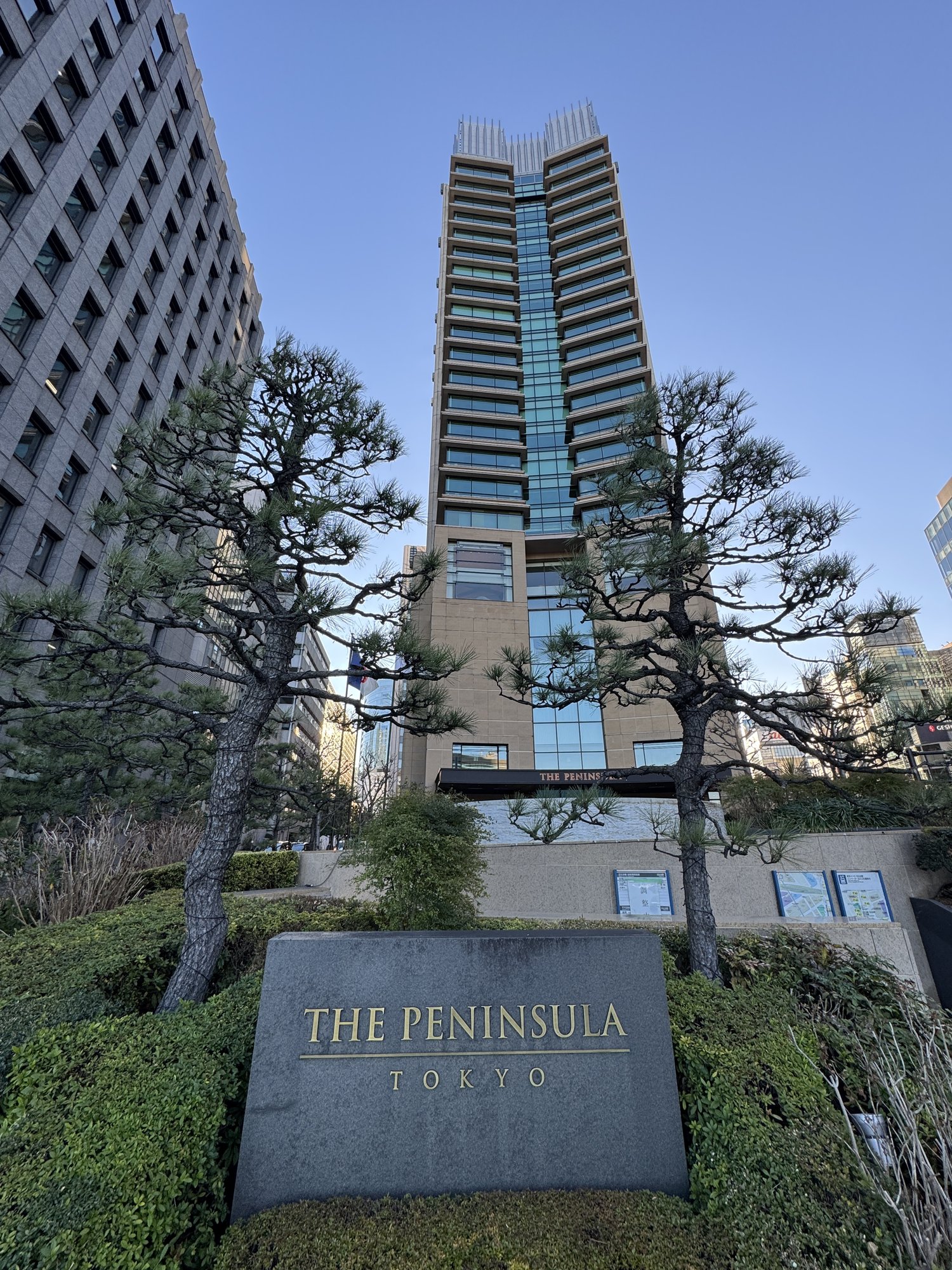
The Peninsula Tokyo has the best address of any big luxury hotel in the city, right across the road from the Imperial Palace gardens with Ginza a few minutes' walk away, and the service is polished and quietly warm. The pool is lovely and Peninsula Time (check in at 6am, leave at 10pm) is a gift after a long flight. But the rooms haven't really changed since 2007, and you feel it. It's a hotel I like a lot, held back by rooms that badly need the renovation the owners have now approved. See pictures ↓
The Peninsula Tokyo opened in 2007 in its own 24-storey tower in Yurakucho, on the corner where Hibiya Park, the Imperial Palace gardens and Ginza all meet. It's the only Peninsula in Japan, and for a long time it was one of the hotels people meant when they said "the best hotel in Tokyo".
I booked it because everyone who knows Tokyo has an opinion on it. Half the people I asked told me it's still their favourite in the city. The other half loved it too, with one big BUT…the rooms are SO dated. And in August 2026 the owners approved a big renovation of the Tokyo and Hong Kong hotels, with no start date yet. So I wanted to see it as it is now, before the builders arrive, and work out whether it's still worth the money.
A typical night is about $850. That's usually a bit less than the Four Seasons at Otemachi and a bit more than the Palace Hotel. For the location and the service, it's fair. For the room, it's a lot.
Things I Loved about The Peninsula Tokyo
The location.
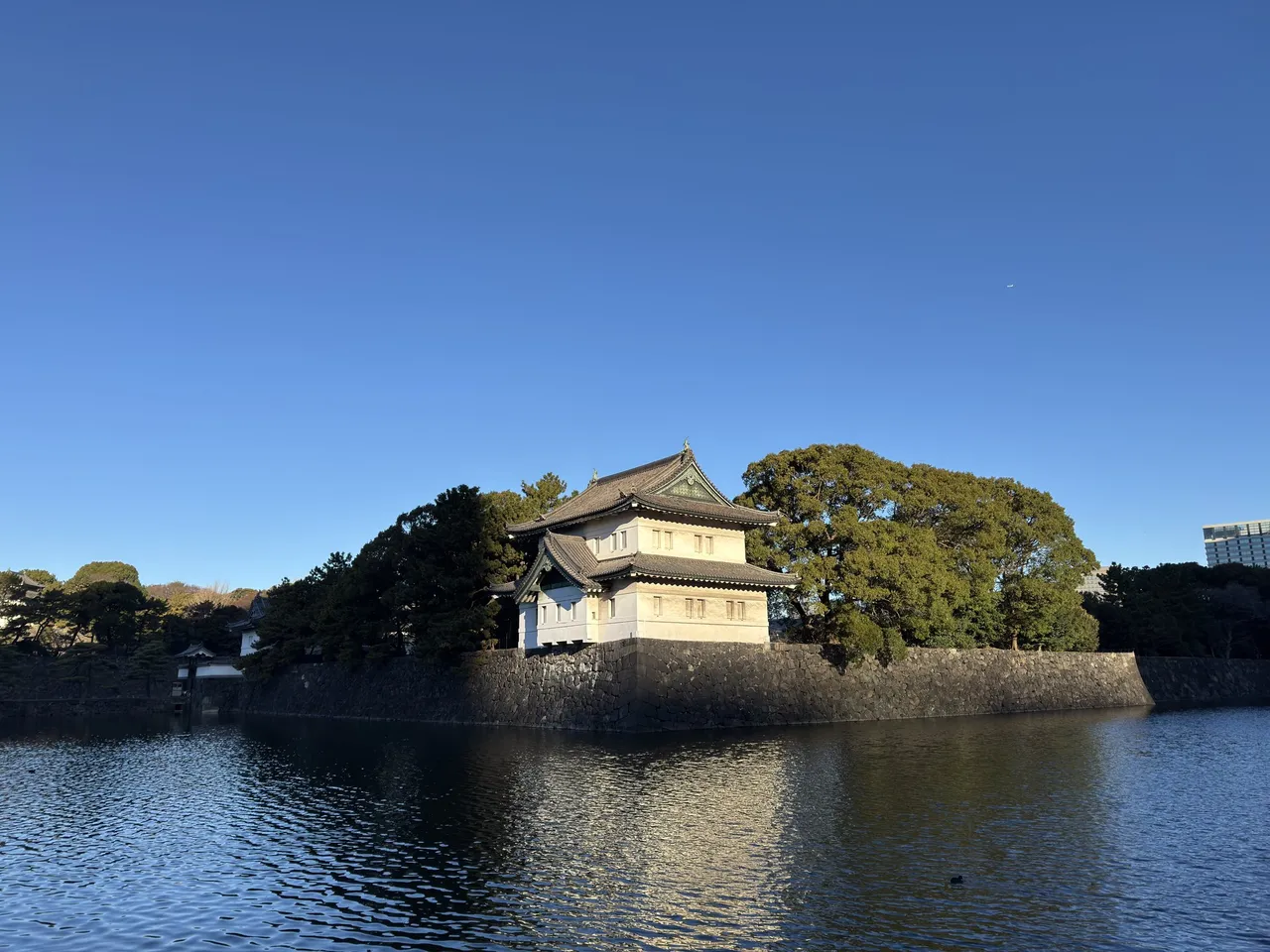
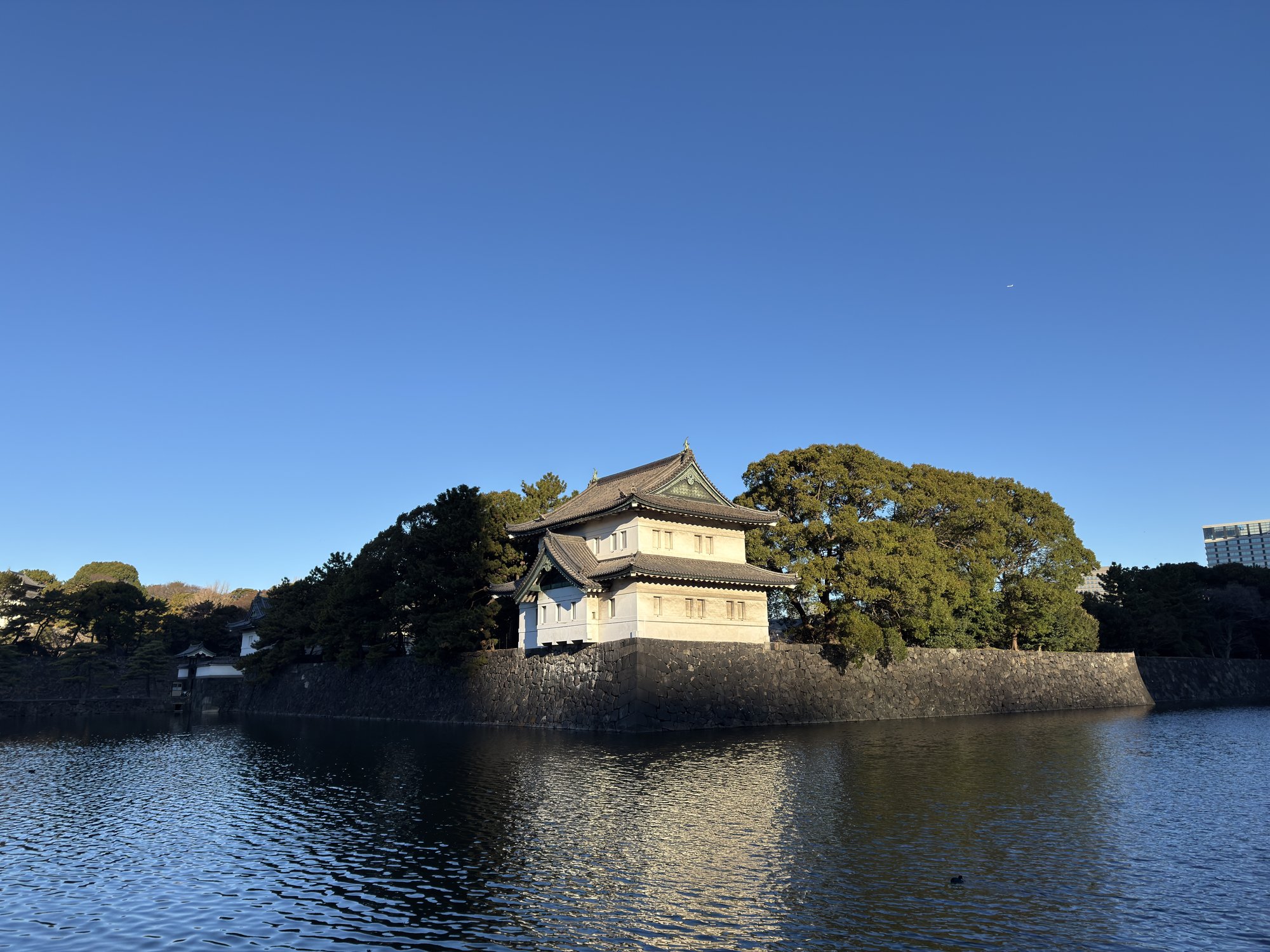
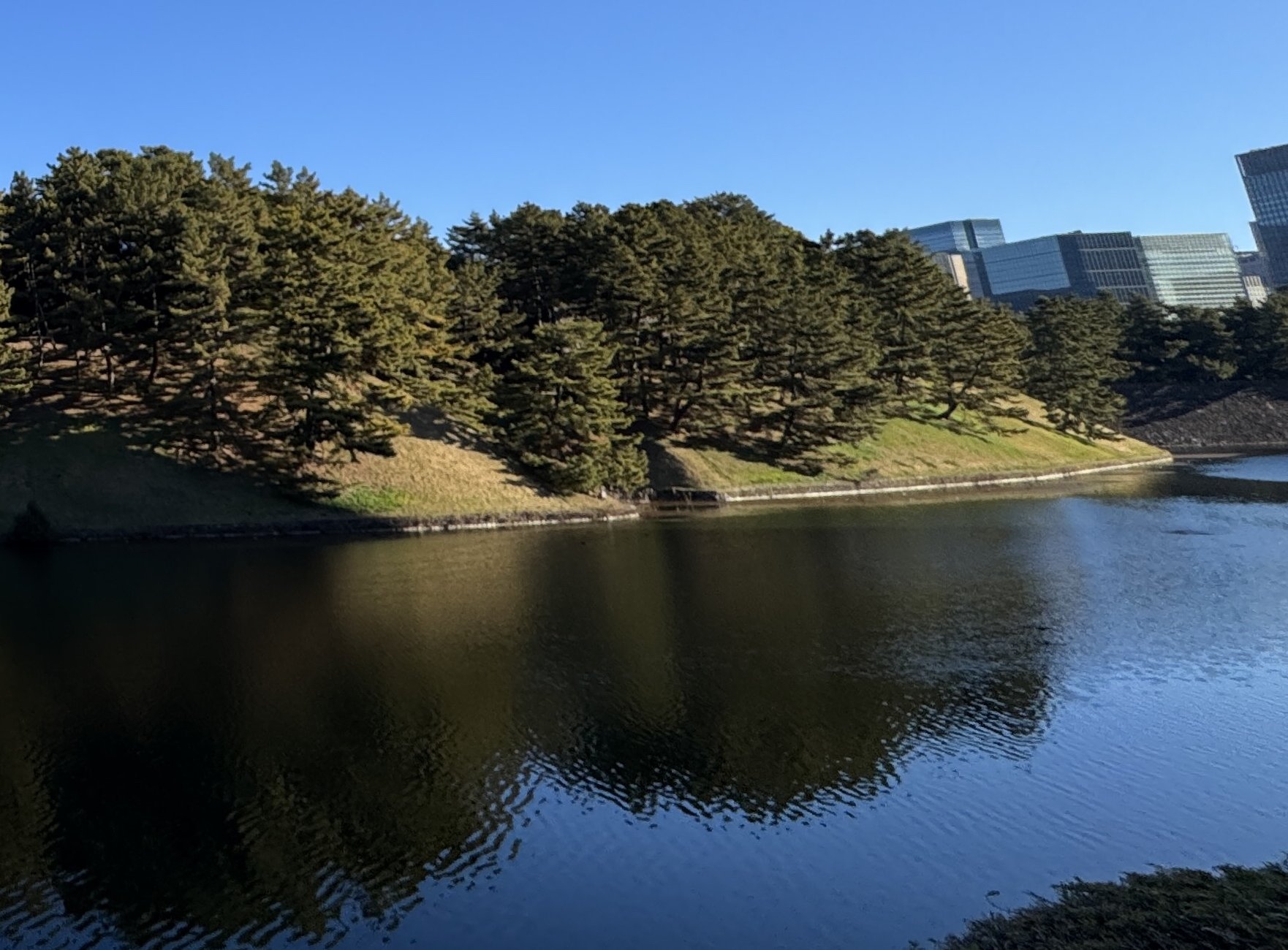
I don't think any big luxury hotel in Tokyo has a better spot. The palace moat is across the road, the old white watchtower is a short stroll along it, Hibiya Park is next door, and Ginza is a few minutes' walk the other way. Hibiya station is right under the hotel (you go down to the basement and walk straight into the station without ever going outside, which is BLISS in summer), Yurakucho station is round the corner, and Tokyo Station is one stop on the train or about 15 minutes on foot. In the mornings I jogged round the palace gardens before breakfast, and in the evenings we walked to dinner in Ginza. Every taxi driver in the city knows where it is.
The arrival.
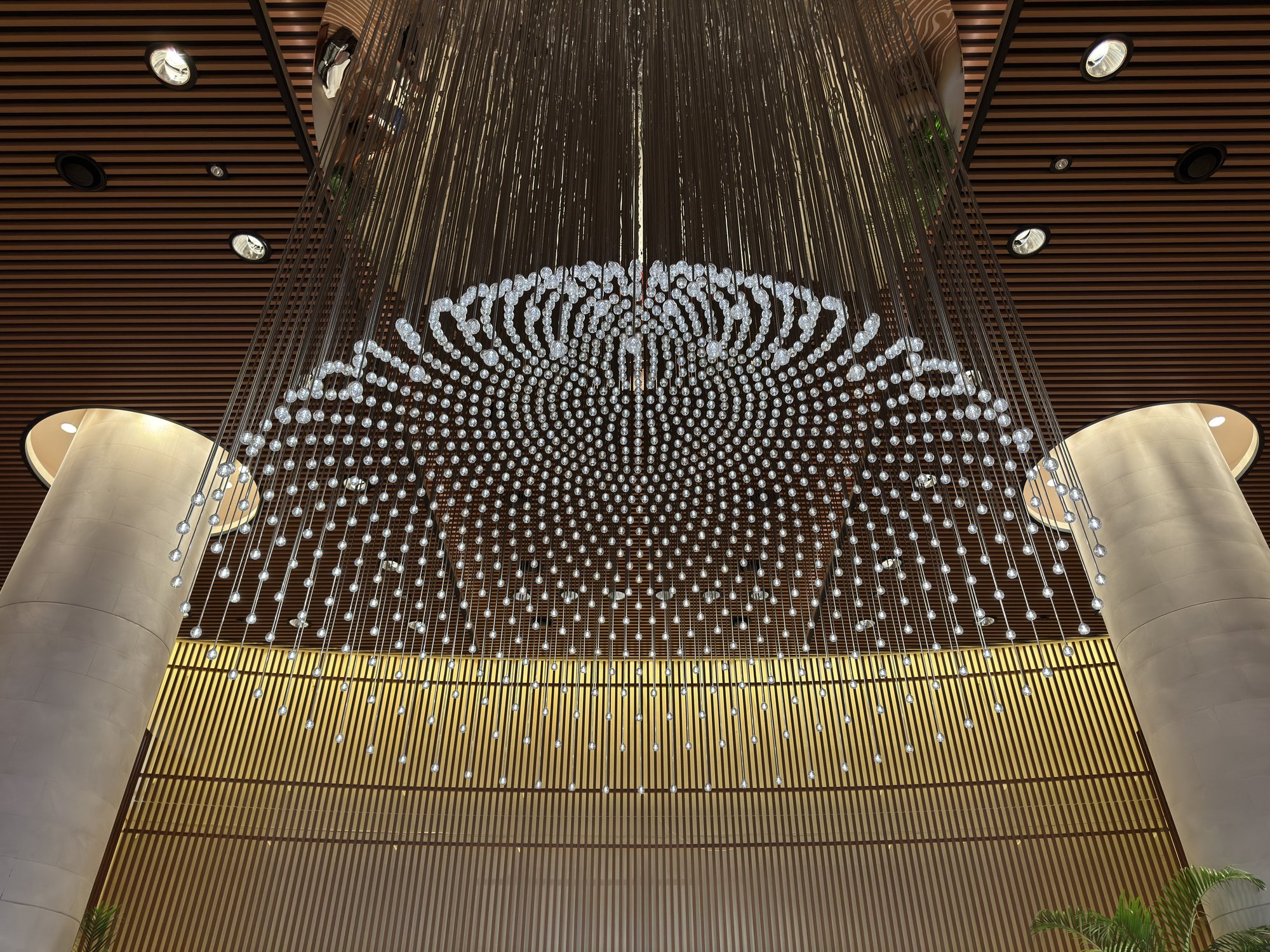
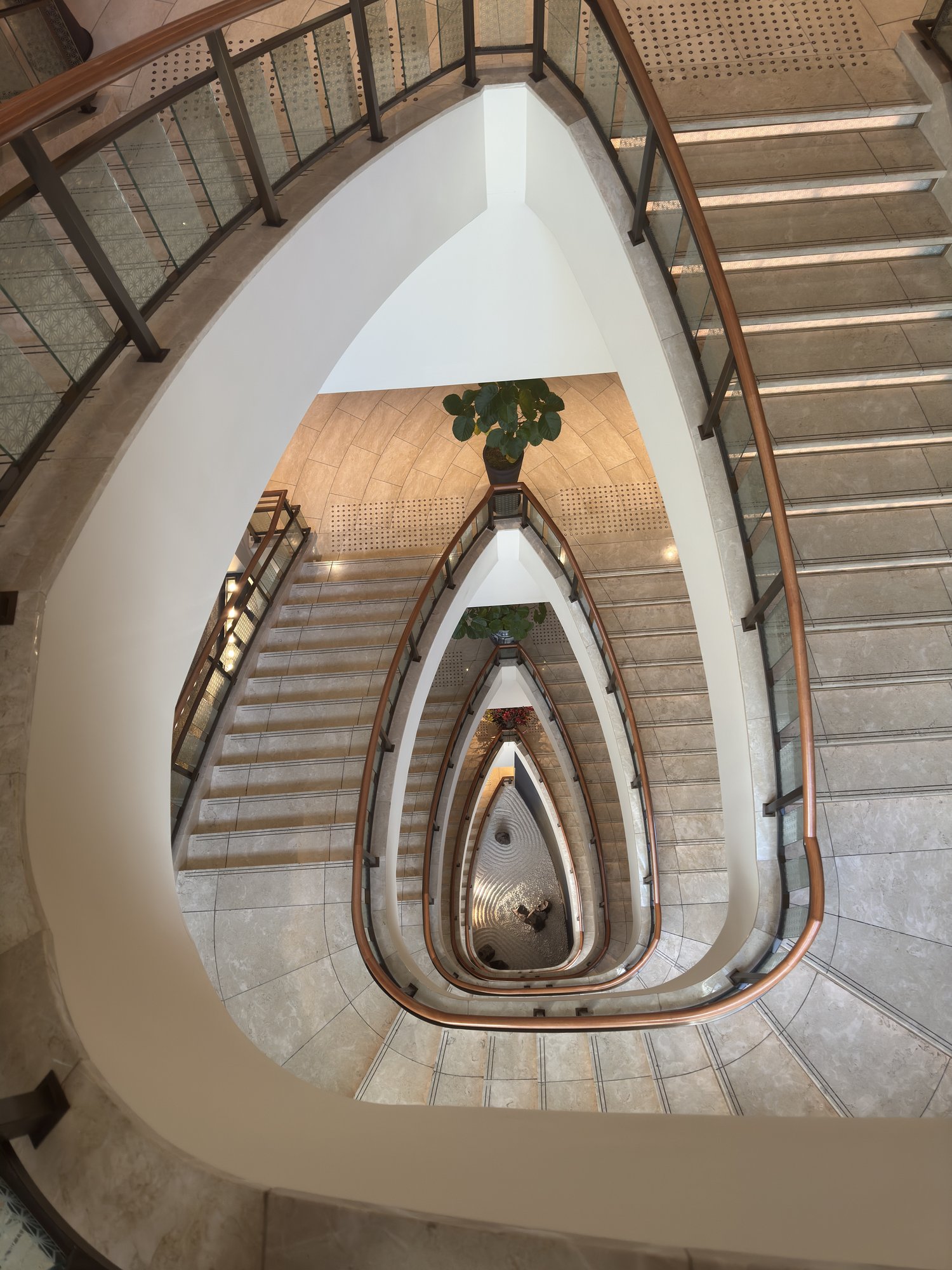
Two stone lions guard the door, the pages are in white uniforms, and the Peninsula's green Rolls-Royces wait in the forecourt. Inside, the lobby has a huge chandelier of hanging crystal strands, meant to look like fireworks, and a sweeping bamboo sculpture by Keisen Hama called the Lying Dragon Gate. In the lift lobby, a dark shaft is lit with dozens of glowing cones (it's an artwork called The Void) and the lift attendant bows until the doors have closed. It's grand in an old-fashioned way, and I loved it.
The service.
The staff here are precise and quietly warm. They never hover, and things just get done. Housekeeping restocked everything almost before we'd noticed it was gone. When we called down from the room, the line was never engaged, not once. The concierge is very well connected and got us into places I'd have struggled to book myself. The front desk speaks good English, and they gave our little one's breakfast free without us asking.
Peninsula Time.
This is the best perk in any Tokyo hotel, and it's open to anyone who books direct or through an advisor, with no status needed. Ask at least 24 hours ahead and you can have your room from 6am on arrival and keep it until 10pm on the day you leave. We landed early in the morning after a long flight, went straight to bed, and then on the last day we swam, packed slowly and left for the airport at dinner time. If they can't have your room ready at 6am, they give you a hospitality room to shower in. After a red-eye from Europe or the US, it's like getting a free night.
The dressing room and the valet closet.
Even the entry rooms (54 square metres, which is very big for Tokyo) have a walk-in dressing room the size of a small bedroom, with a vanity, benches for your suitcases and a nail dryer (yes, really, and it's become hotel folklore). By the door there's a valet closet that opens from the corridor too, so you leave your shoes or shirts in it, press the "Valet Service" button and they come back clean and pressed. You could do a week here with hand luggage.
The pool and spa.
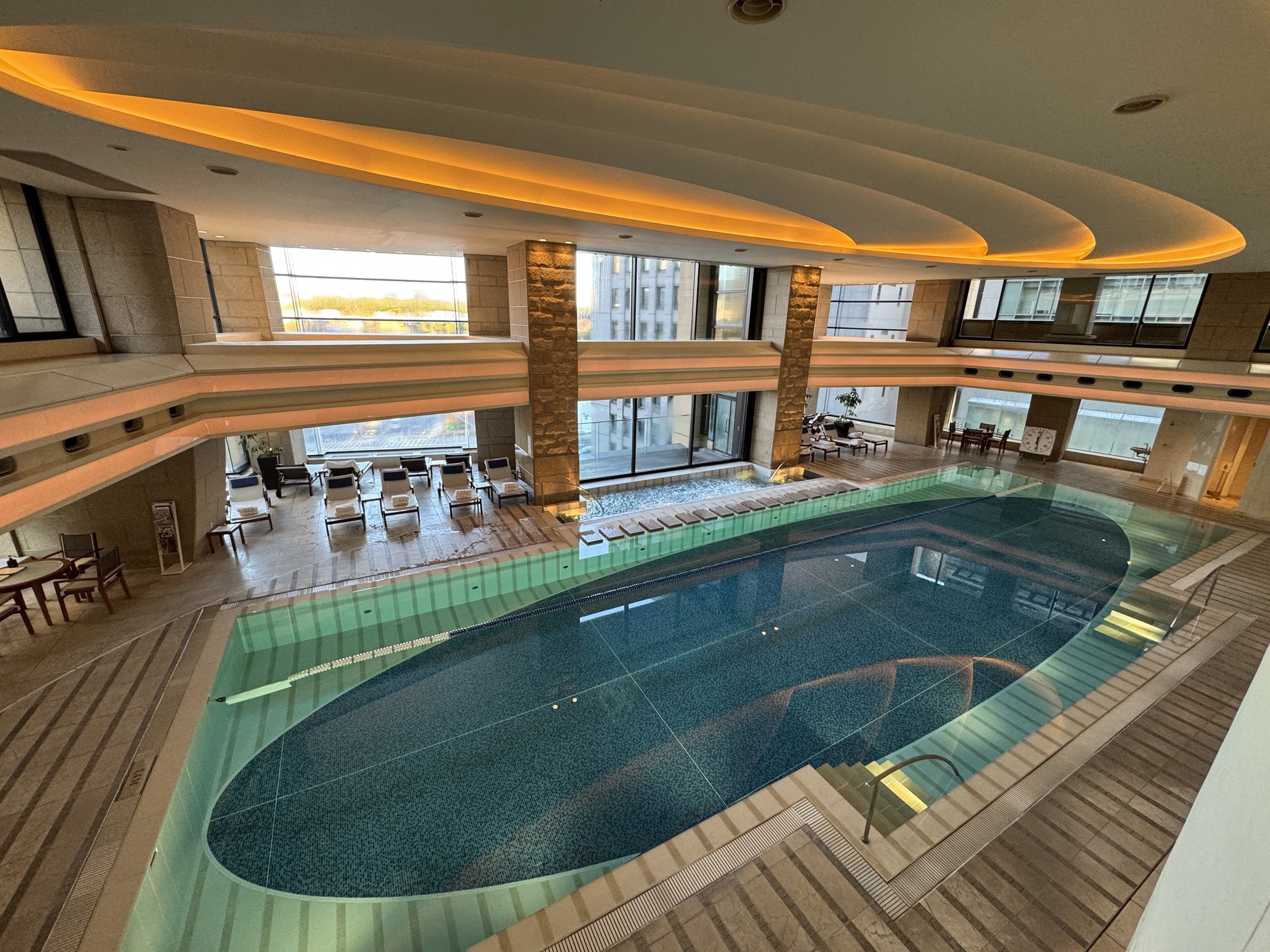
The spa is two floors joined by a spiral staircase, and it's the calmest place in the building. The 20-metre pool is properly heated, with curved amber light panels in the ceiling, and you can actually swim laps. Next to it there's a vitality pool with a bench under the water and LOTS of bubbles, looking out towards the Imperial gardens. I lost a whole afternoon in there. The changing rooms have a sauna, a steam room and a shaved-ice fountain to cool off, and the gym is open round the clock.
Dim sum at Hei Fung Terrace.
Hei Fung Terrace, on the second floor, is the hotel's Cantonese restaurant, done up like a Suzhou garden, and lunch there was one of my favourite meals in Tokyo. The dim sum comes on tiered stands, each piece in its own little compartment. The Shanghai pork dumplings and the steamed abalone were the standouts.
Dinner at Peter.
Peter, on the 24th floor, used to be a steakhouse. These days it's a Modern French restaurant under chef Yohan Da Costa. Almost every ingredient is Japanese…Hokkaido hair crab in a silky chawanmushi-style custard, Gifu tomato with caviar and shiso, Kumamoto beef to finish. Our table looked out over the city lights, and it's some of the most confident French cooking I've had in Tokyo. Have a Manhattan at Peter: The Bar next door afterwards, with its chrome tree sculptures and purple light.
The tower at night.
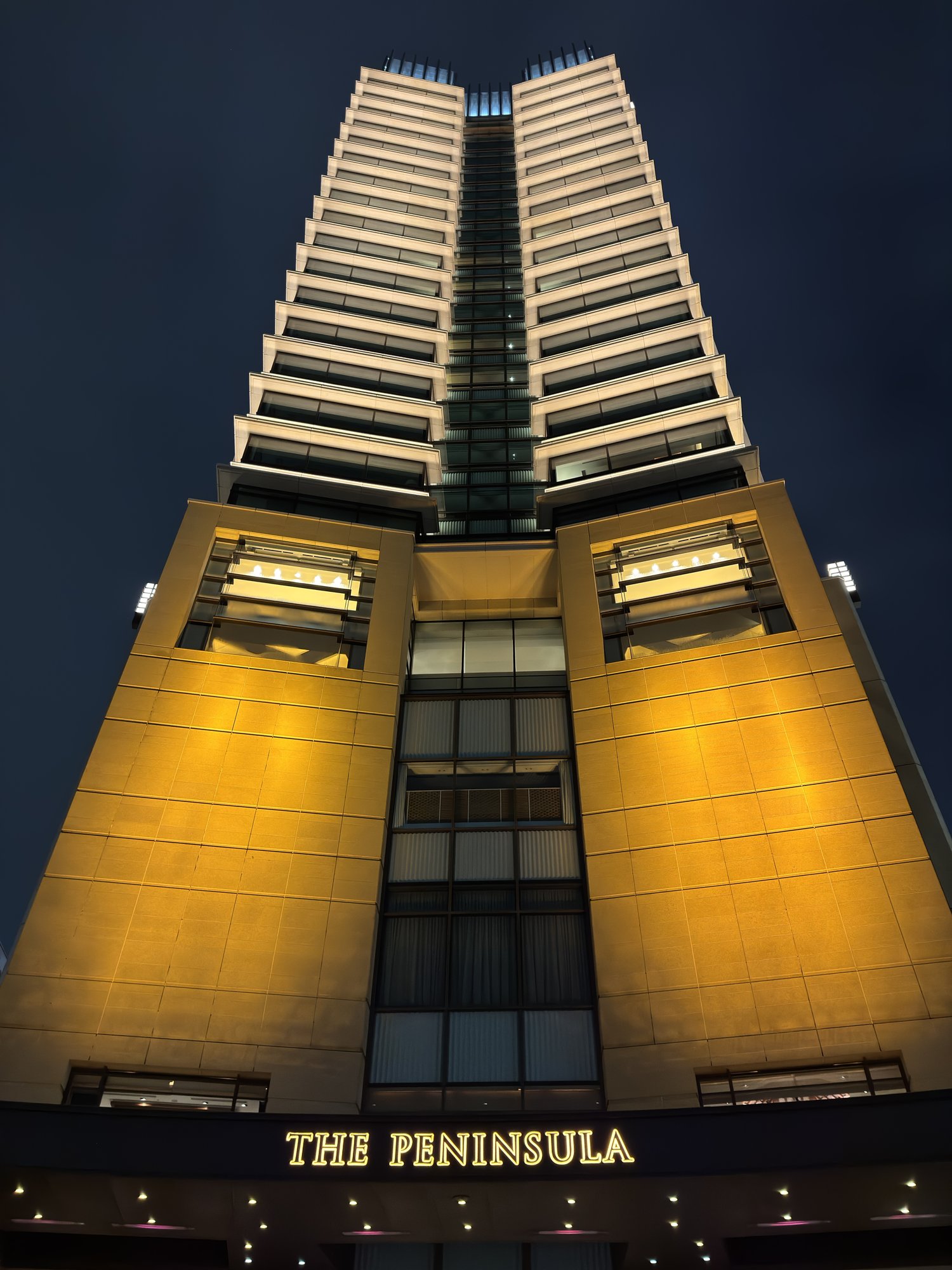
Walk back from Ginza after dark and the whole tower is lit gold, like a lantern on the corner of the park. I've seen a lot of hotel facades, and this is one of the prettiest. From the upper floors you look down over the moat and the palace grounds, with the city beyond.
Things That Could Be Better
The room is dated.
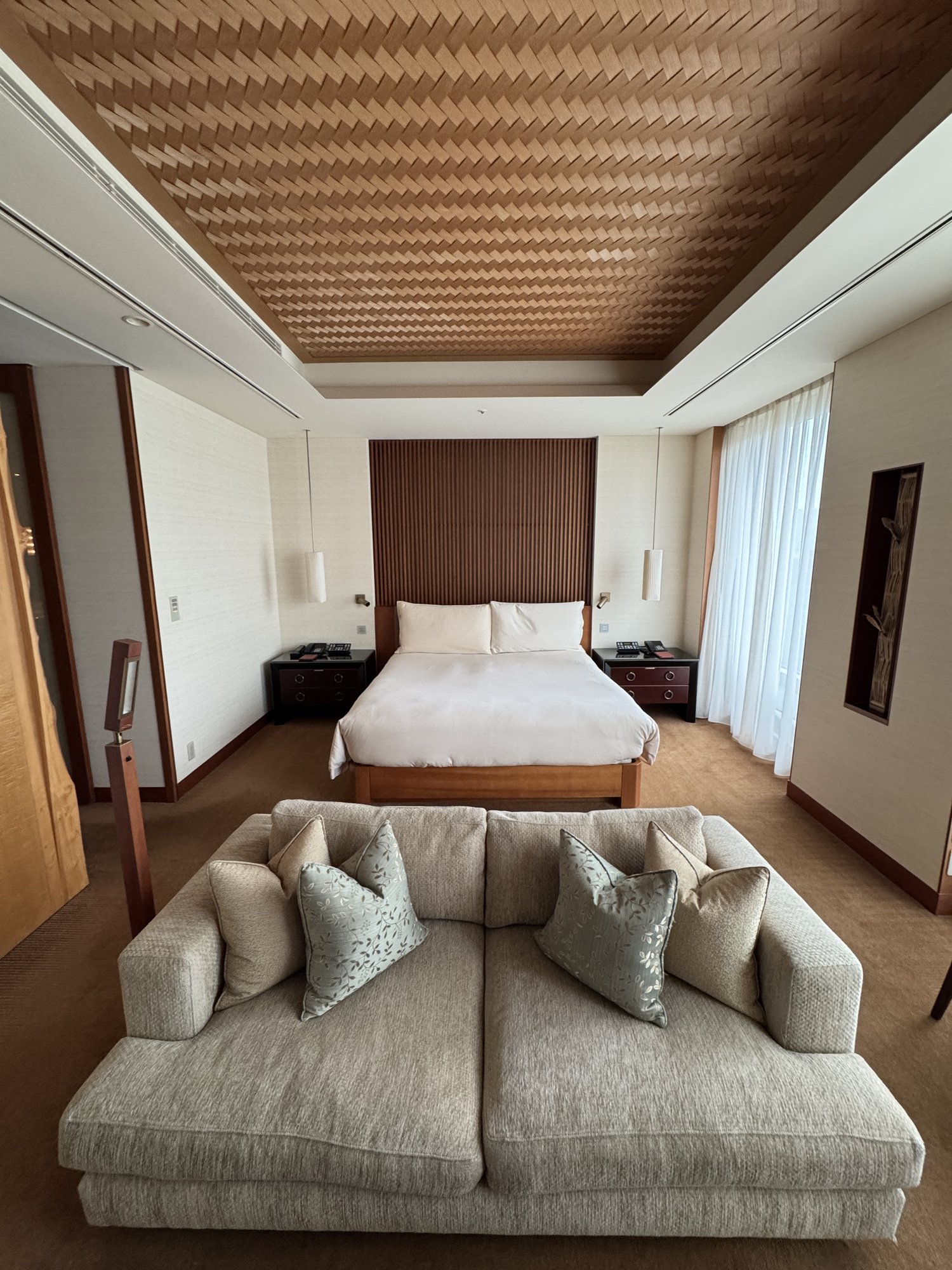
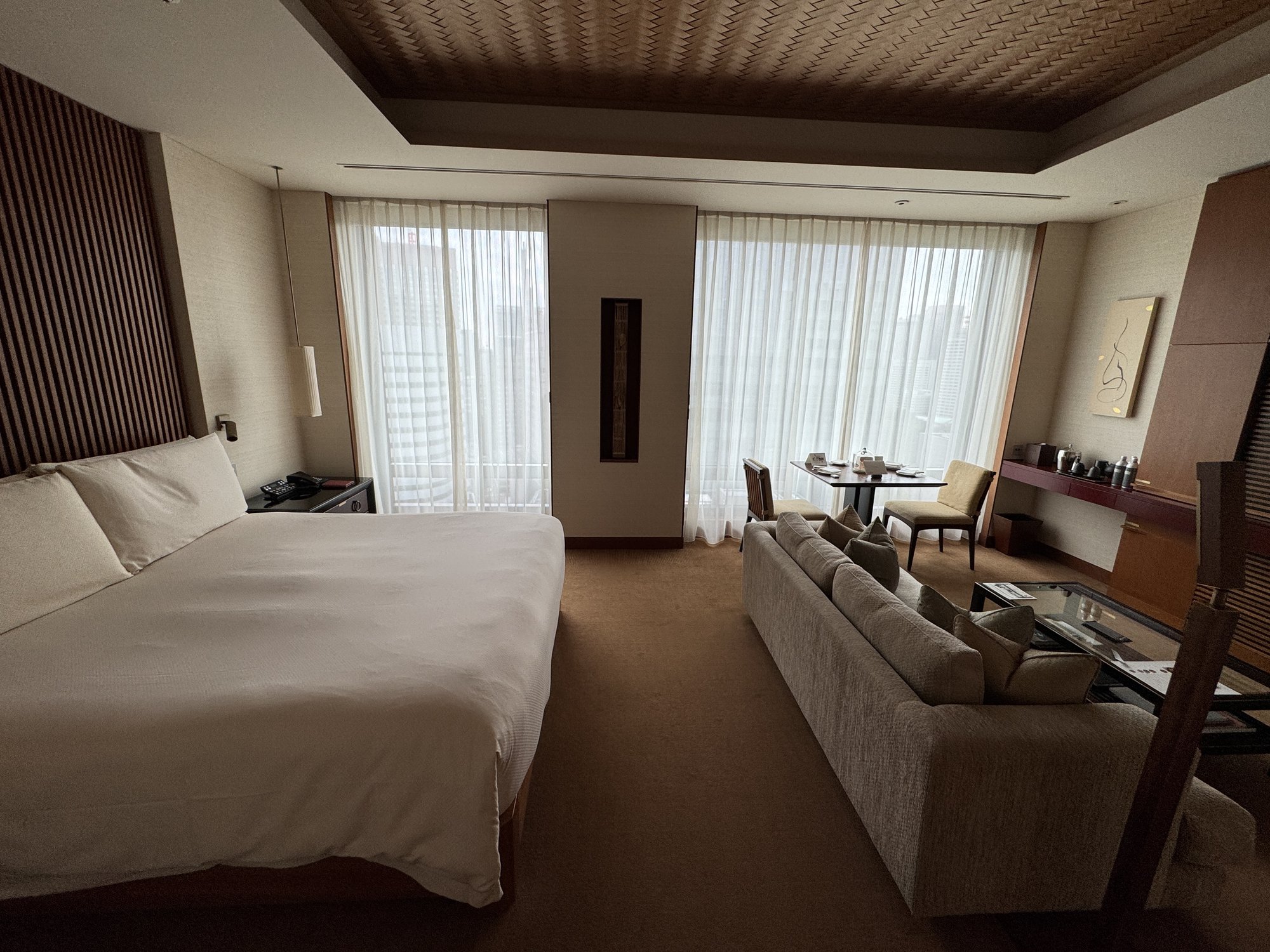
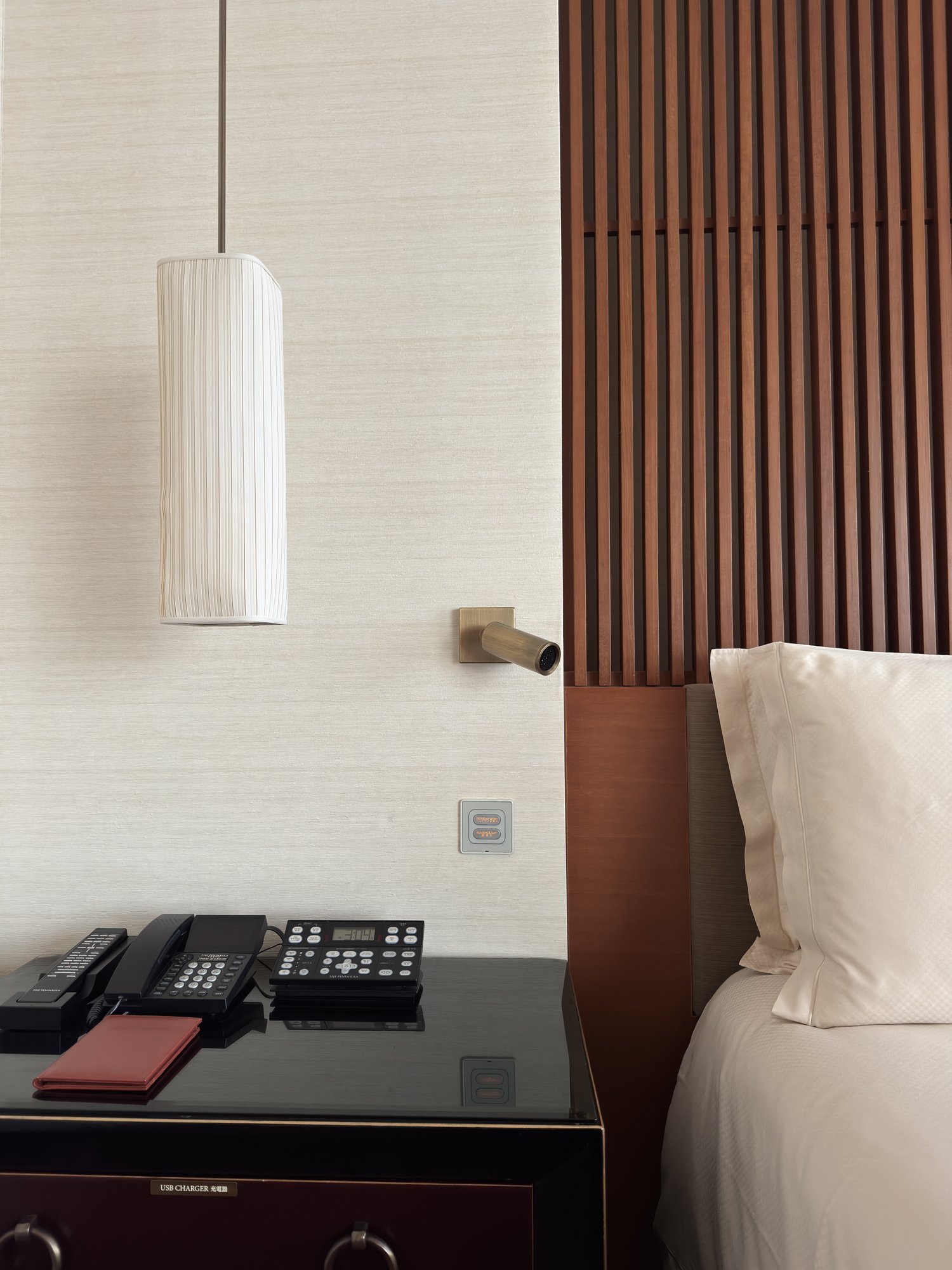
This is the big one. We booked a Premier King, and the front desk moved us up one category at check-in, to a room on the 18th floor. It was spotless and beautifully kept, with no musty smell and nothing broken, and the warm wood, cream and red colours are much nicer than the beige you get in a lot of newer hotels. But it's very clearly a 2007 room. The bedside and wall panels control internet radio, temperature and wind direction, and they look like relics. There's a DVD player and a fax machine, the TV over the bath is the old square shape, and there are buttons and hidden switches EVERYWHERE.
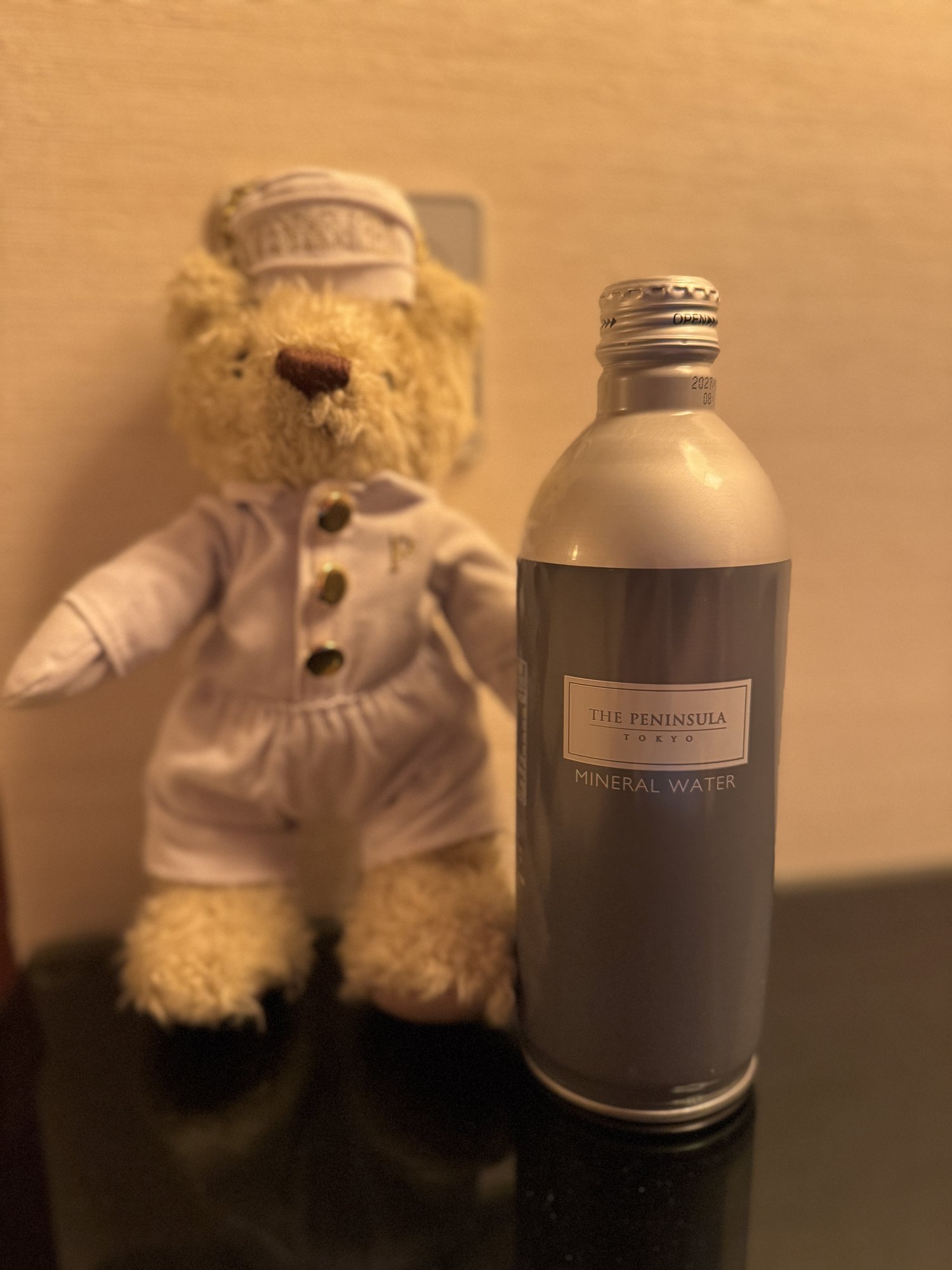
It does have its good points. The woven-wood ceiling is lovely, the blackout curtains make it pitch black at night, and the slippers are the best I've worn in a hotel. The little touches made me smile, too, like the bellboy teddy bear by the bed and the pot of sharpened pencils next to the Peninsula postcards on the desk. The bed is on the firm side, though, and if you're used to the newer Tokyo hotels (the Four Seasons at Otemachi, the Bulgari, Aman Tokyo), the room feels its age next to them.
The bathroom is showing its age too.
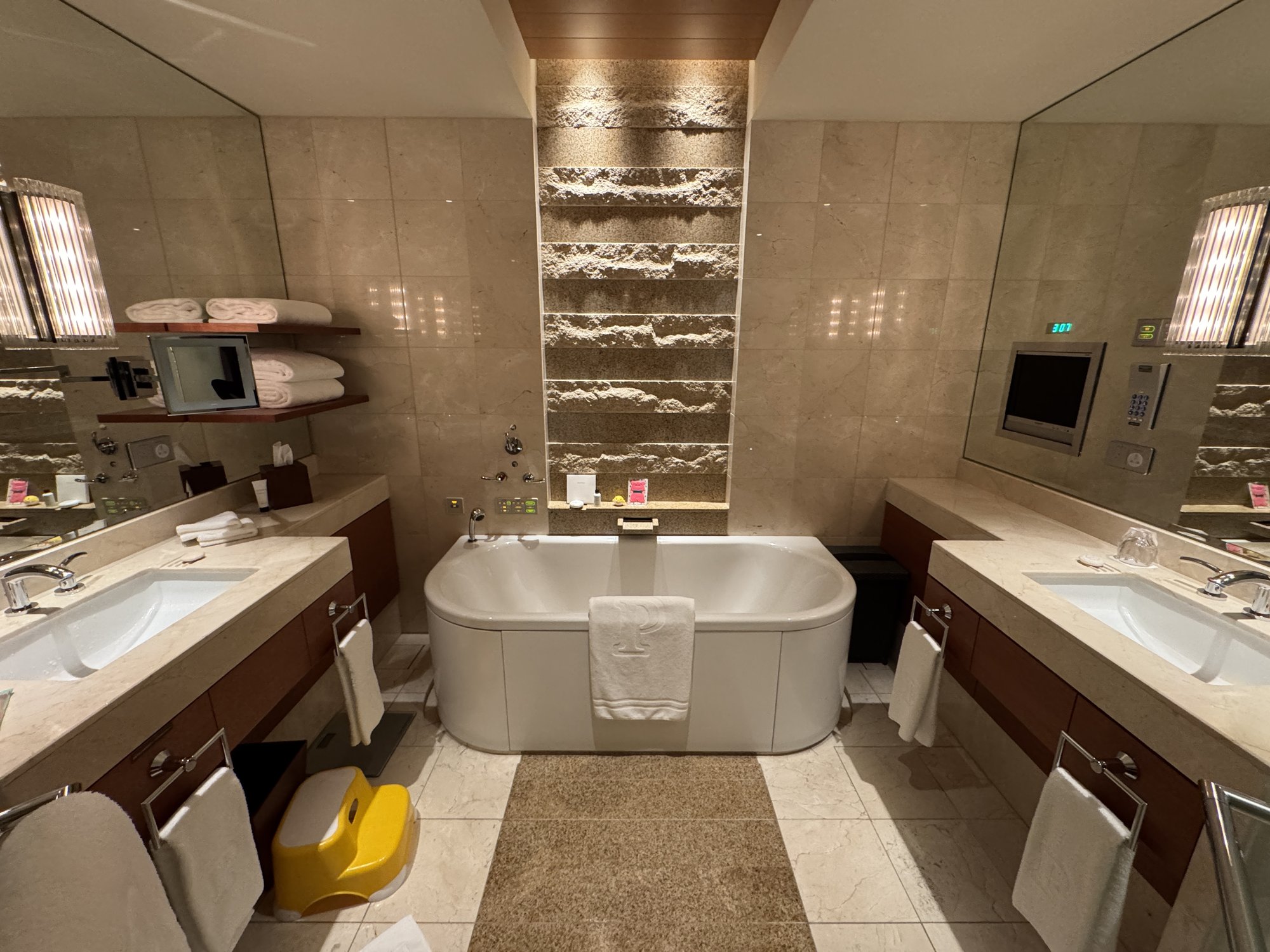
The layout is good. There's a deep soaking tub in front of a stone feature wall, two vanities, a separate shower and a Toto toilet in its own little room, plus lovely bath products made for the hotel by the Japanese perfumer Satori Osawa. But the fittings look tired, and it's the part of the room that most needs the refresh.
Breakfast.
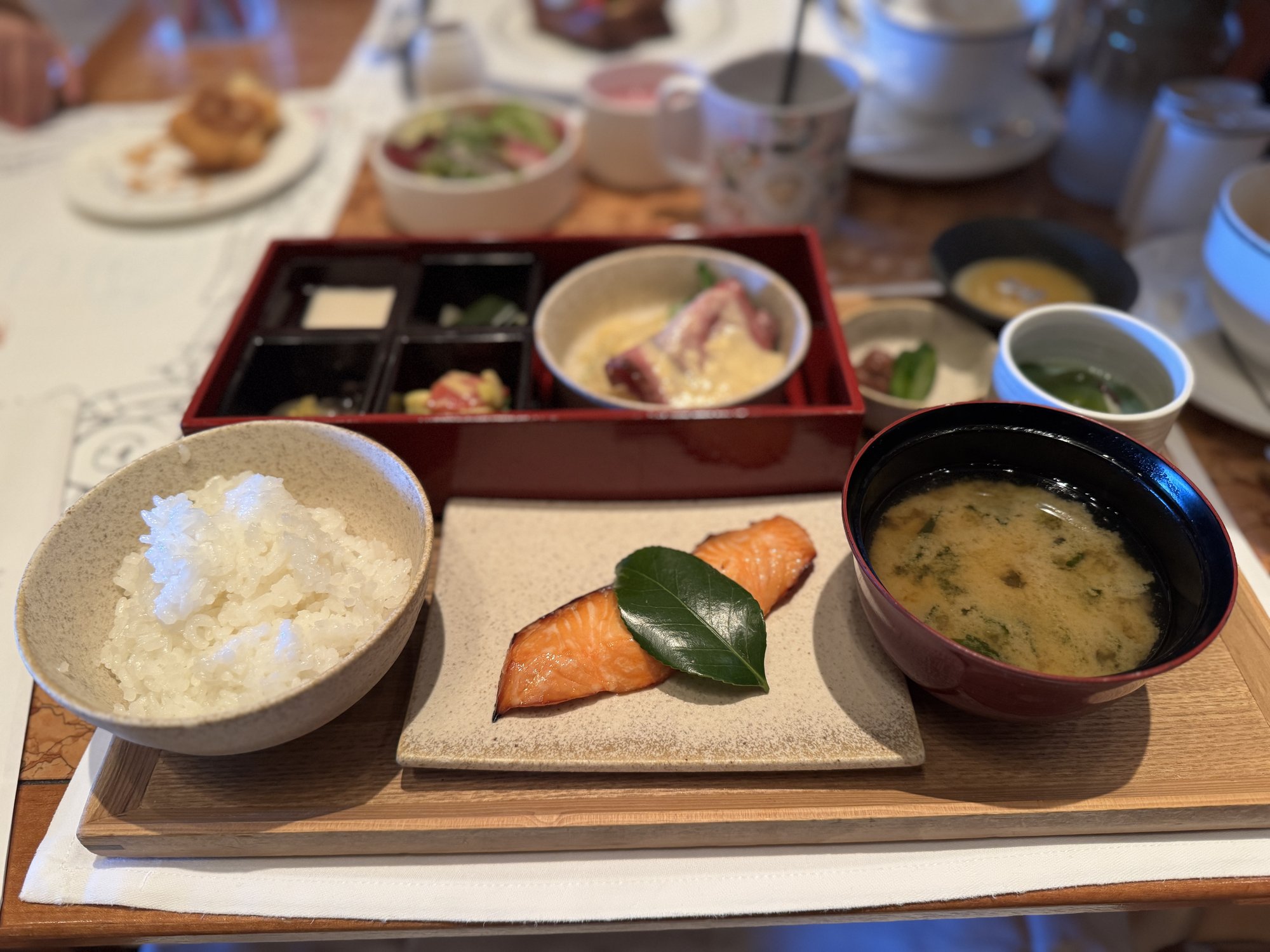
Breakfast is served in The Lobby, which is literally the hotel lobby, and there's no buffet. You pick a set menu (Western, Japanese or Chinese) or order from a short à la carte list. The Japanese set is the one to order (the grilled salmon was very good, with silky tofu, pickles, miso and rice), and the Chinese set is good too. But after a few breakfasts it felt a bit sparse, the tables near the entrance are cramped, and I missed the big breakfasts at the other top hotels in Tokyo.
The lobby gets busy.
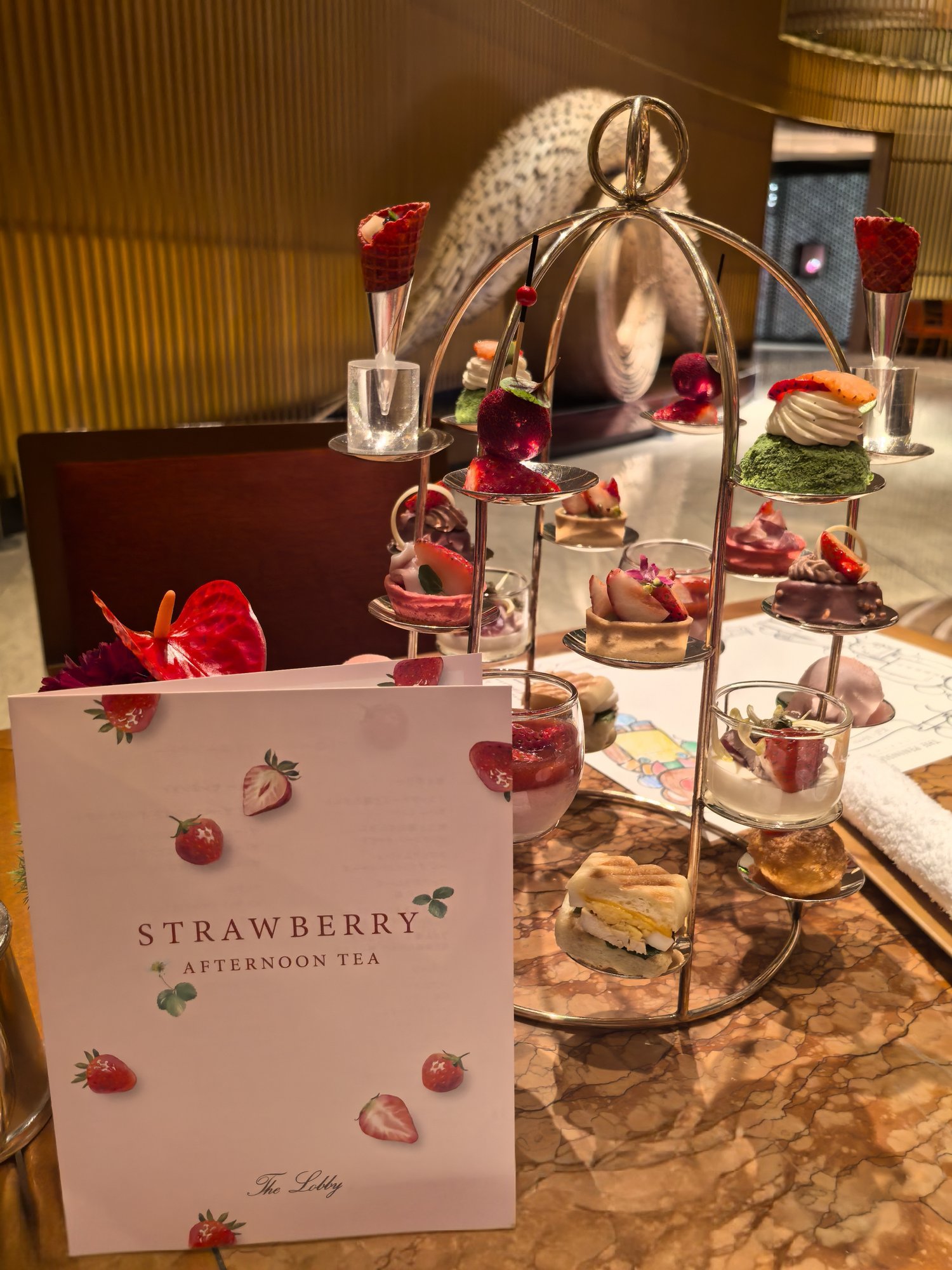
By early afternoon The Lobby is full of people who aren't staying here, queueing for afternoon tea. The tea itself is lovely (we had the strawberry tea, and the scones were excellent), but the lobby is noisy from lunch until evening. Go at the start of service if you can.
A small welcome.
There was no welcome drink after the long flight, and nothing at turndown. It's a small thing, but at this price you notice.
Children.
Kids are welcome and the staff are sweet with them, but there's no kids' club, the gym and sauna are adults only, and children can only swim at set times. With little ones, the city will keep them busier than the hotel.
The Peninsula or the Four Seasons at Otemachi?
These two are about a 20-minute walk apart, at either end of the palace gardens' east side, and they're the pair I'd most often be choosing between.
The Four Seasons wins on the room, and by a lot. It's newer and calmer, with the palace view (and Mount Fuji on a clear winter morning), and it has the better breakfast and the better bar. The Peninsula wins on location (Ginza and Hibiya on foot, against the empty streets of Otemachi at night), on the pool, and on Peninsula Time. It's also usually a little cheaper.
So if the room matters most, book the Four Seasons. If you're landing on a red-eye and want to be in the middle of things, the Peninsula is the better pick, and once the renovation is done it might be the best hotel in Tokyo again. For the Nihonbashi alternative, see my Mandarin Oriental Tokyo vs The Peninsula Tokyo comparison.
Overall
I think the Peninsula Tokyo is right for people who care about where they're staying more than what the room looks like: first-timers who want to walk to Ginza, anyone arriving on a long-haul red-eye, and people who love old-school grand-hotel service. It's the wrong pick if you want a modern room with a big view, or a lavish buffet breakfast.
For a newer room on the palace gardens, book the Four Seasons at Otemachi. For the palace view for less, the Palace Hotel. And for a room high above the city with the Skytree in the window, Mandarin Oriental Tokyo in Nihonbashi.
So here's my bottom line. I gave it 7.9 out of 10. The location, the service and the pool are the best things about it, the dated rooms and the lobby breakfast are the worst, and once the renovation is finished I'll be back to see it.
If you're booking it
Book a Premier Room (the same 54 square metres as the Deluxe, on a higher floor) and ask for the palace side. If you want a park or palace view guaranteed, the Grand Premier Park Room (63 square metres) is the one to book. Ask for Peninsula Time at least 24 hours before you arrive. Book through a Peninsula PenClub travel advisor and you get breakfast for two, a hotel credit and an upgrade when one's available. Book Peter and Hei Fung Terrace before you go, and go early for afternoon tea. Hibiya station is under the hotel, and Haneda is about 20 kilometres away. Before you book, check whether the renovation has started, and ask which floors are affected.
More on the area: Japan guide.